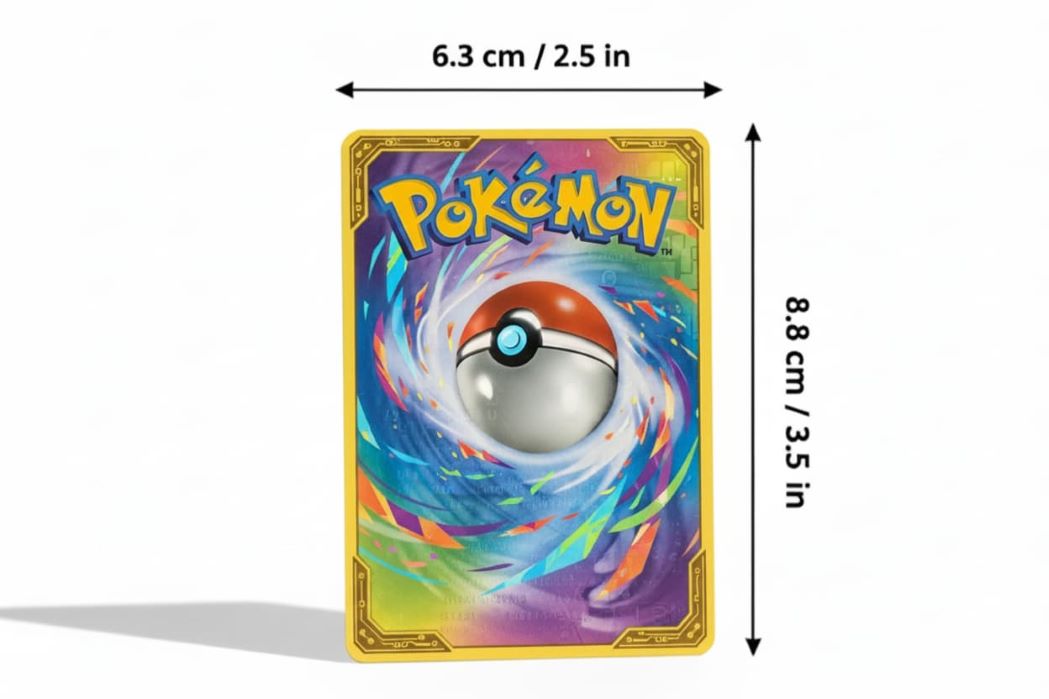
A standard Pokémon card measures 2.5 x 3.5 inches, or 63.5 x 88.9 millimeters, or 6.35 x 8.89 centimeters. These measurements apply worldwide, including Japanese and international cards, and have remained consistent since the Pokémon Trading Card Game began in 1996. Knowing the exact size helps you pick sleeves, deck boxes, and binders that fit perfectly, keeping your cards protected and in mint condition. Whether you collect vintage prints or play in modern tournaments, understanding these dimensions ensures accurate storage and long-term preservation.
Standard Pokémon Card Dimensions
Every official Pokémon card follows the exact measurement: 2.5 inches wide and 3.5 inches tall. In metric terms, that equals 63.5 millimeters by 88.9 millimeters or 6.35 by 8.89 centimeters. The Pokémon Company International defines this size standard and has kept it consistent since the game’s release.
The standard thickness ranges from 0.25 to 0.30 millimeters, while premium foil or textured cards can reach 0.76 millimeters. Thickness and weight vary because of foil layers, surface coatings, and cardstock density. On average, a single card weighs about 1.75 to 1.8 grams.
This consistent sizing makes Pokémon cards compatible with other popular trading card games. Pokémon cards share identical dimensions with Magic: The Gathering cards, while Yu-Gi-Oh! Cards are slightly smaller. The comparison below clearly highlights the difference.
| Card Type | Inches | Millimeters | Notable Difference |
|---|---|---|---|
| Pokémon | 2.5 × 3.5 | 63.5 × 88.9 | Standard TCG size |
| Magic: The Gathering | 2.5 × 3.5 | 63.5 × 88.9 | Same as Pokémon |
| Yu-Gi-Oh! | 2.3 × 3.3 | 59 × 84 | Slightly smaller |
Uniform sizing helps you organize collections from multiple games. It also ensures that sleeves, binders, and grading slabs fit correctly, preventing edge wear caused by sleeves that are too tight or too loose.
Jumbo and Oversized Pokémon Cards
Jumbo Pokémon cards are larger, collectible versions officially released by The Pokémon Company for promotional events or special collector sets. These cards are not tournament-legal and are primarily designed for display. The modern jumbo card measures 5.25 × 7.25 inches, or about 133 × 184 millimeters (13.3 × 18.4 centimeters). This format became the standard around 2020, replacing the older 6 × 8-inch versions used in early promotional releases.
Each jumbo card usually weighs between 6 and 8 grams, depending on the cardstock and coating finish. Because of their size and heavier weight, they need specific protection. Collectors often use rigid top loaders, frame displays, or custom sleeves designed for 5 × 7-inch prints.
Unofficial jumbo cards are also found online, but only official releases follow the proper Pokémon standard. You can recognize them by the official Pokémon logo and consistent printing quality. Jumbo cards stand out for their detailed artwork and rarity, often featuring event-exclusive illustrations or limited holographic effects. They don’t fit in standard binders or decks, but they add visual appeal to any collection. Knowing their exact dimensions helps you choose the right sleeves and display options to prevent curling or surface damage over time.
Pokémon Card Sleeve and Storage Dimensions
Protecting Pokémon cards starts with using sleeves that match their exact size. The standard sleeve for Pokémon cards measures 2.6 × 3.6 inches (or 66 × 91 millimeters). This slight increase from the card’s 2.5 × 3.5-inch size ensures a secure but flexible fit that prevents corner wear and scratches during shuffling. Pokémon cards use slightly larger sleeves than Yu-Gi-Oh! Cards, so avoid mixing them when buying supplies.
Collectors who prefer a tighter layer often use perfect-fit sleeves, sized exactly at 2.5 × 3.5 inches (63 × 88 millimeters). Many players double-sleeve valuable cards by first placing them in a perfect-fit sleeve, then in a standard outer sleeve. This protects against dust, moisture, and edge scuffing. Reliable brands like Ultra Pro and Dragon Shield offer durable sleeve options trusted by competitive players and collectors.
A standard deck box holds 60 sleeved cards or 80 unsleeved cards, making it ideal for tournament decks. Binders use 9-pocket sheets designed for cards sleeved up to 66 × 91 millimeters. Grading slabs differ from regular sleeves, providing hard-shell protection for professionally graded cards. For long-term preservation, collectors should use acid-free, non-PVC polypropylene sleeves, which prevent yellowing and chemical damage.
Before purchasing storage supplies in bulk, always check product dimensions. Some brands vary by one or two millimeters, and tight sleeves can cause bending. Store your cards in a cool, dry place with low humidity to prevent warping or fading. Proper sizing and care keep your collection organized, display-ready, and protected for years.
Japanese and International Pokémon Card Differences
Japanese Pokémon cards follow the exact official dimensions as international versions, measuring 2.5 × 3.5 inches (63.5 × 88.9 millimeters). This ensures perfect compatibility across sleeves, decks, and binders. You can freely mix cards from different regions without any storage or gameplay issues.
The slight variations come from separate printing facilities and manufacturing standards in Japan and the United States. Japanese cards use slightly denser cardstock and thinner laminate, making them a bit heavier and smoother. These qualities give them a cleaner finish and make them especially popular among collectors.
Japanese prints often feature narrower borders and distinct holo patterns, such as reverse holo or glossy promo textures, unique to their region. Despite these design differences, all cards still fit standard sleeves, binders, and grading slabs perfectly.
If you enjoy comparing designs from different generations, try discovering new favorites with the Random Pokémon Generator. It’s a fun way to explore regional and vintage Pokémon while learning their card variations.
Digital and Design Template Dimensions
Digital Pokémon card templates follow the same aspect ratio as physical cards. The correct design size is 2.5 × 3.5 inches at 300 DPI, which equals roughly 750 × 1050 pixels. A 300 DPI setting is the printing industry standard and ensures professional-quality sharpness for both text and artwork. Lower resolutions, such as 150 DPI, often cause blurred edges or distorted borders.
When designing for print, always include a 3-millimeter bleed margin on each side to allow precise trimming without cutting into the frame. Use RGB mode for digital previews and CMYK for printing to preserve accurate colors. File formats like PNG, PSD, or AI maintain clarity and color depth, which is essential for cards with gradients or holographic overlays. Official Pokémon cards use offset printing, a process that hobby printers can’t fully replicate, so that fan-made cards may look slightly different.
These same design guidelines also apply to online card mockup tools or digital fan art generators. Maintain the 2.5 × 3.5 ratio so printed cards fit standard sleeves and deck boxes. Double-check scaling before printing to prevent edge misalignment and ensure your designs match official proportions.
Conclusion
Understanding Pokémon card dimensions is essential for both players and collectors. The standard size remains 2.5 × 3.5 inches, consistent across all modern sets and regions. Jumbo cards follow larger formats designed for display, while sleeves and binders are built to match these exact proportions.
Knowing these measurements helps you choose proper sleeves, design accurate custom cards, and maintain collection quality. Correct sizing also matters during card grading and professional valuation, where precision affects authenticity and score. By following official dimensions, you ensure every card stays protected, fits perfectly, and retains its value over time.
Every Pokémon card, from Japanese editions to promotional jumbo prints, follows a shared design system that balances playability, durability, and visual appeal. Treat your collection with the same care professionals use, and it will remain organized, preserved, and ready to showcase for years to come.
Frequently Asked Questions
What are the dimensions of a Pokémon card?
A standard Pokémon card measures 2.5 × 3.5 inches, or 63.5 × 88.9 millimeters. This size matches other trading card games like Magic: The Gathering. Be cautious with unofficial or counterfeit cards, as they often vary slightly in size or thickness.
Are all Pokémon cards the same size?
Yes. All official Pokémon cards, including Japanese and English versions, share the exact dimensions. This consistency lets you use the same sleeves and binders for cards from any region.
What are the jumbo Pokémon card dimensions?
Modern jumbo cards measure 5.25 × 7.25 inches (133 × 184 millimeters). Older promotional versions were slightly larger, around 6 × 8 inches.
What size sleeves fit Pokémon cards?
You can use standard sleeves measuring 2.6 × 3.6 inches (66 × 91 millimeters) for a comfortable fit. For tighter protection, use perfect-fit sleeves sized 2.5 × 3.5 inches. Trusted brands like Ultra Pro and Dragon Shield offer reliable options that maintain card condition.
What is the size of Pokémon cards in centimeters?
Standard cards measure 6.35 × 8.89 centimeters. Jumbo cards measure 13.3 × 18.4 centimeters.
Are Japanese Pokémon cards smaller?
No. Japanese cards are the same size as international cards. Differences appear only in border style, texture, and print finish, not in dimensions.
Can I print my own Pokémon card templates?
Yes. You can design and print your own cards on a 2.5 × 3.5-inch canvas at 300 DPI (about 750 × 1050 pixels). Official Pokémon cards use offset printing, which is not replicable at home, so personal prints are for fan or hobby use only.